Good morning, welcome to our Horizon Scanning newsletter and Happy New Year!
The return to work this January comes with unprecedented levels of industrial action. In today’s bulletin, we look at the contingencies that companies can put in place in 2023 so that strikes do not erode business resilience. Our Monday Toolbox delves deeper into the question of how you do this.
Thanks for reading and stay safe.

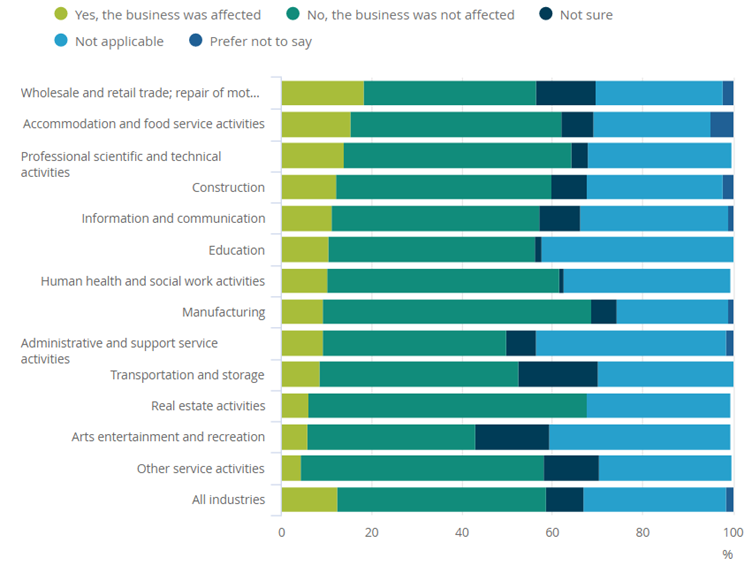
Was your business affected by the industrial action over Christmas and the New Year? With transport and postal sectors on strike, along with several others, Reuters report that one in eight UK firms have been adversely affected. The chart below, taken from ONS data underpinning their piece, reveals that hospitality and wholesale industries have been at the sharp end. (This article goes into more detail on why).
Furthermore, Bloomberg write that 417,000 UK work days were lost in October 2022 thanks to strikes – the highest of any month for eleven years. This month and next could easily eclipse this.
The relevance of all this to business continuity is clear, with many companies heavily reliant on the organisations striking. The Reuters article finds that smaller companies have been especially hard hit.
This press release from the Institute of Export, meanwhile, outlines some of the key impacts of the strikes on logistics sector. Some of the industrial action listed has been less heavily reported in the media, such as the port strikes in Liverpool and Felixstowe. But these events could have a particularly big impact on supply chain resilience.
For many organisations, the consequences of strike action are indirect – the result of cancellations, deadline misses or staff unable to get to work – rather than the direct consequence of employees taking to the picket lines. It can seem, therefore, like something to be absorbed or ‘taken on the chin’ rather than planned for. The effect is also more of a ‘drip-drip’ than a sudden crisis; hence industrial action often fails to score highly on risk registers.
Moreover, the very high levels of industrial action seen recently have not been a major feature of life in the UK for a few decades. So there is often relatively little by way of institutional memory.
All of these factors are reasons to be warier rather than less and to plan ahead as much as possible. The current rise of industrial action does not look to have peaked, with one FT article describing them as “an inevitability, not an aberration”. Successful organisations will have plans in place to minimise economic harm over the next six months. Our Monday Toolkit includes a few ideas on the steps you can take.
Question for the month:
What impact has the strike action had on your business?
Below are some of the analyses and suggestions we have found so far, for managing the business risks of industrial action.
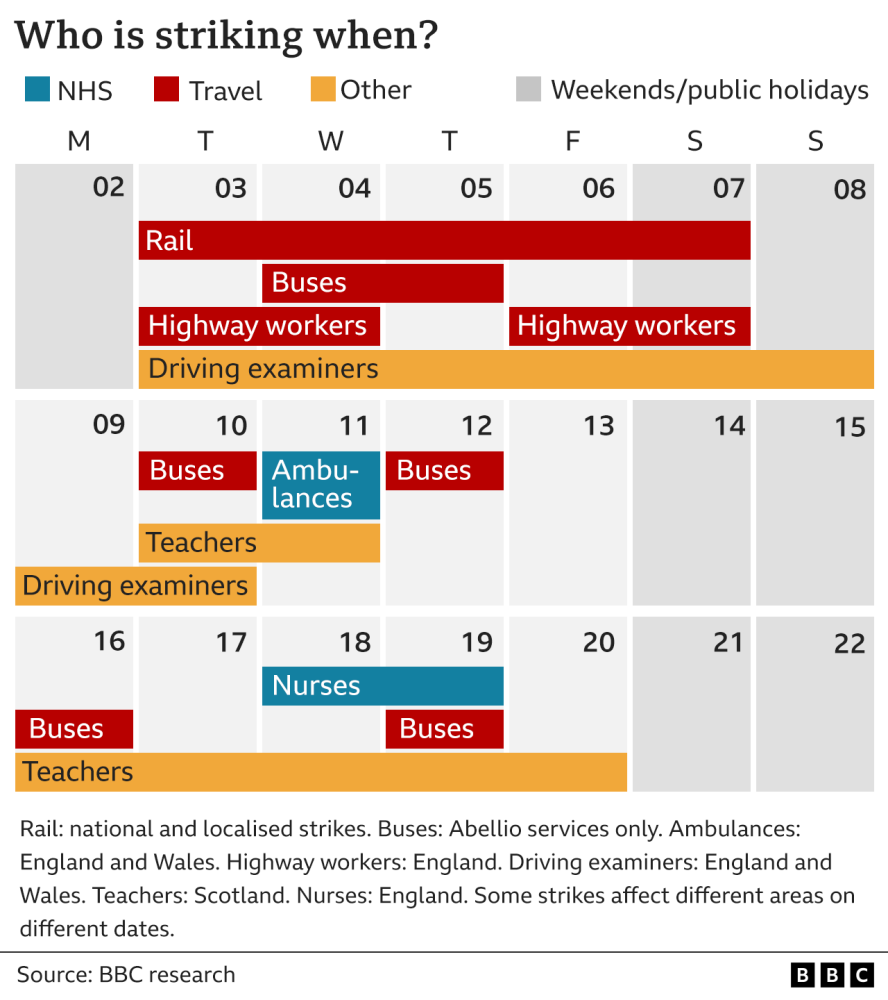
- This BBC page provides a regularly updated calendar of strikes (pictured below, as of last week), as well as information on how close each dispute is to resolution. It is worth your organisation monitoring, in one place, this sort of information, so that you have a grid of which strikes are pending, and can form a plan to manage their impact.
- This piece by Computer Weekly has some interesting advice on the cyber impacts of industrial action. They have three key pieces of guidance: do not get complacent (about malware attacks, which heighten during chaos); do not leave employees stranded; and show clients you are still up and running. The second point, about staff, is especially important. If your team are all back in the office then this may be a good test of how strong your remote working capacity is.
- Lastly, this BCI article assesses the risks posed by postal strikes and what businesses can do to mitigate them. A big focus is on supply chains. David Window, Director at Continuity Shop, is interviewed for the piece and sets out three issues to focus on here: an audit of priority suppliers (including contingencies), a closer relationship with procurement professionals and a detailed overview of all your business’s Service Level Agreements. Supply chains are an area where Horizonscan has done a lot of work in the past, and one which we have written about in this newsletter before. A period of sustained industrial action could place them under unprecedented strain.
Thought for the week:
“With strikes becoming more common, businesses need to prepare for the impact these events might have. Relying on one travel route or postal services is not currently a safe bet. Businesses must have contingencies across all areas of the organisation.”