
Horizonscaning Newsletter
We are entering 2026 in what is often described as a VUCA environment — volatile, uncertain, complex and ambiguous. What is striking is not simply the number of risks facing organisations, but how tightly interconnected they have become.
Disruptions no longer sit neatly in one category. A cyber incident becomes a supply chain issue. Environmental change triggers business interruption. Geopolitical decisions translate rapidly into cost pressures, regulatory shifts and operational constraints.
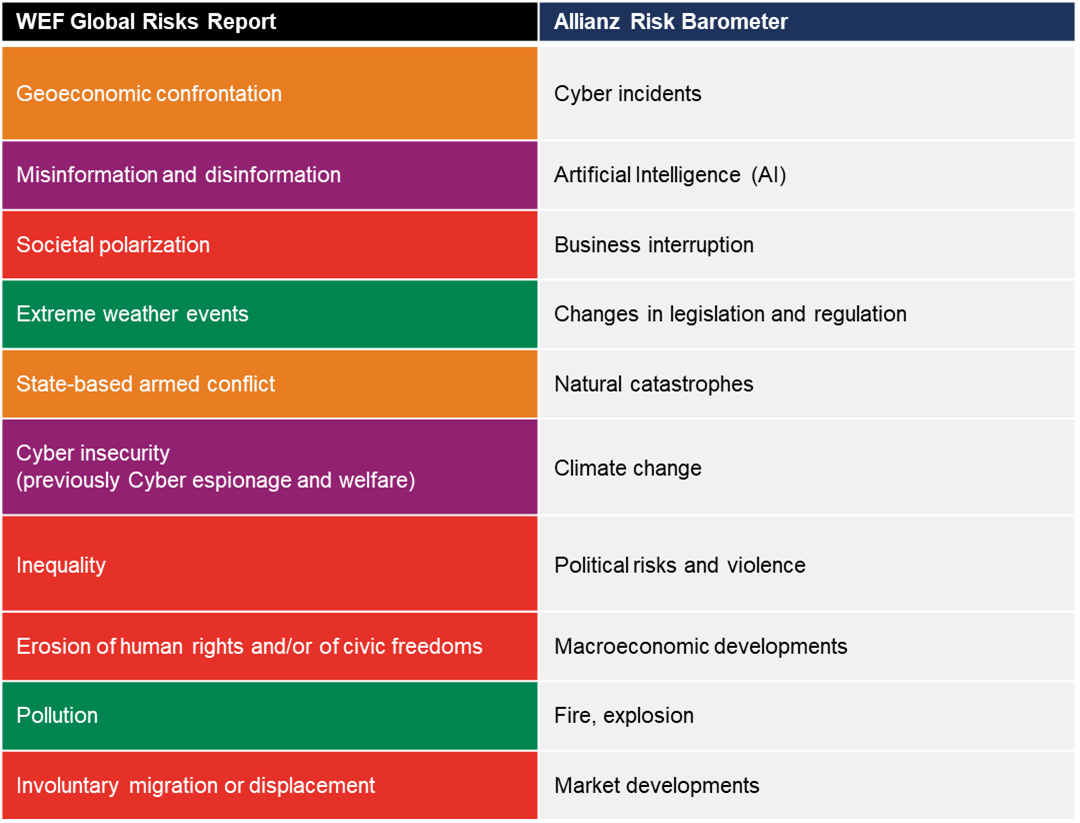
Drawing on the World Economic Forum Global Risks Report 2026, the Allianz Risk Barometer, and Horizonscan’s own risk and exercise data, this edition highlights the risks that matter most and, critically, why preparedness and decision-making remain decisive.
In 2025, Horizonscan delivered over 60 exercises across Europe, North America, Asia and Africa, with scenarios spanning fire, cyber attack, extreme weather, supply chain disruption, product recall and employee misconduct. The most frequently tested scenarios were fire-related incidents, IT outages and extreme weather, often combined with media or reputational escalation.
Cyber Risk: Dependency, Concentration and Cascading Impact
Cyber risk continues to rank as a leading global threat, but its nature is evolving.
Today, cyber exposure increasingly reflects organisational dependence on a small number of critical third parties for data, infrastructure and digital services. Over 60% of global cloud infrastructure is controlled by just three providers — AWS, Microsoft Azure and Google Cloud. This concentration creates powerful efficiencies, but also systemic vulnerability.
Recent large-scale cloud outages and supplier disruptions have demonstrated how a single failure can cascade across geographies, industries and supply chains within hours.
In our 2025 exercise data, cyber attack and IT outage scenarios were among the most frequently delivered simulations, including cases involving data breach, ERP failure and internet loss. Increasingly, these exercises extend beyond IT teams to include executive leadership and communications functions.
Cyber resilience is no longer an IT issue — it is a business continuity and third-party risk challenge.
Artificial Intelligence: A Distinct and Rapidly Maturing Risk
While often grouped with cyber, artificial intelligence represents a distinct and fast-emerging risk category.
Since the launch of generative AI tools in 2022, adoption has accelerated at an extraordinary speed. For many organisations, AI is now embedded in daily operations — often faster than governance, assurance, and accountability frameworks can keep pace.
The risks are less about system compromise and more about:
- Implementation challenges and over-reliance on automated outputs
- Liability and accountability gaps, particularly where human decision-making is removed or diluted
- Misinformation and disinformation, amplified at scale and speed
Both highlight adverse outcomes of AI as a rapidly rising concern over the next decade. From a resilience perspective, the question is no longer whether AI will be used but how its use is governed, tested and assured.
Geoeconomic Confrontation and Geopolitical Volatility
Geoeconomic confrontation has emerged as the top global risk for 2026, reflecting a year marked by conflict, sanctions, tariffs and strategic competition.
What is different today is the speed with which geopolitical decisions translate into operational impact. Trade restrictions, regulatory divergence, and political volatility are reshaping supply chains, investment decisions and market access in near-real time.
Traditional, rules-based approaches to geopolitics are increasingly supplemented and sometimes displaced by leadership style, personality and short-term strategic signalling. For organisations, this creates an environment in which predictability declines and flexibility becomes essential.
The macroeconomic consequences — inflationary pressure, cost volatility, and uncertainty — are already being felt across sectors.
Environmental Change and Natural Hazard Exposure
Rather than viewing climate as a distant or abstract issue, there is growing recognition that environmental change is an immediate operational and financial risk.
Extreme weather, flooding, wildfires and infrastructure stress continue to drive business interruption and insurance losses globally. Significantly, regulatory and market responses are accelerating. In countries such as Italy and Greece, organisations are now required to hold insurance coverage for natural hazards, including floods, wildfires and earthquakes — reflecting a shift from awareness to mandated risk transfer.
At Horizonscan, we deliberately avoid the term “natural disasters.” Human decisions, planning and preparedness shape disasters. The same environmental event can cause minor disruption to one organisation and existential damage to another. In 2025, extreme weather, flood and power-loss scenarios featured prominently in our exercises across Europe, North America, Asia and Africa. In several regions, weather-driven disruption was tested alongside staff shortages, infrastructure outages or supply chain interruptions, reflecting its role as a compound risk.
Environmental change also acts as a risk multiplier, amplifying supply chain disruption, workforce impacts and infrastructure failure.
Supply Chain Fragility and the Role of Readiness
Modern supply chains have been optimised for efficiency, not resilience. Just-in-time manufacturing, lean inventories and global sourcing leave little margin for disruption.
Supply chain fragility consistently appears in both global risk reports and Horizonscan’s own future-trend analysis. However, supply chain risk rarely fails in isolation; it is triggered or intensified by cyber incidents, geopolitical shifts, environmental events or infrastructure outages.
In this context, organisational readiness is not a risk in itself, but the factor that determines outcomes.
Our 2025 exercise data shows that organisations most frequently test scenarios involving:
- Fire
- IT outage
- Extreme weather
Recent exercises have increasingly combined supply chain disruption with operational stressors, such as ERP system outages, raw material contamination and staff shortages. These scenarios rarely fail in isolation; they compound.
What This Means for Leaders in 2026
Despite unprecedented access to data, analytics and AI, every organisation still needs to be able to:
- Identify and understand its key risks
- Understand what could stop operations
- Assess mitigation measures, including insurance and identify gaps
- Prepare people to make decisions under pressure
Risk is not a future problem. It is happening now.
The organisations that struggle in 2026 will not be those that failed to spot the risks, but those that lacked the tested capability, clarity of ownership and confidence in decision-making to respond when risks materialised. Across 2025 exercises, sessions involving 15–30 senior participants routinely generated 20–30 actionable recommendations, highlighting that even well-prepared organisations uncover significant gaps in decision-making, escalation and governance when tested under pressure.
As pressure on leaders continues to grow, investing in people, preparedness and practical resilience remains one of the most effective ways to navigate uncertainty.
Horizonscan news
Joely Austen graduated last week with a First Class Honours degree. We are so proud of our team, who constantly push themselves to deliver high-quality CPD.
Our Horizonscan team earned the Certified Business Continuity Professional (CBCP) certification from the DRI International (Disaster Recovery Institute). This means our team is dual-certified.
We’re pleased to be running the DRI International Business Continuity (BCLE 2000) course.
📅 Dates: September 7–10, 2026
📍 Format: Web-based ⏱ Duration: 4 full days of instruction + online exam (at your leisure)
📜 Includes: Course + Qualifying Exam
🌍 Pathway to certification: CBCP, ABCP, MBCP, CFCP or CBCV.
Interested in joining or learning more? Get in touch https://lnkd.in/eAKpFesY
We joined UCL Institute of Education at their Risk, Disaster and Humanitarian Careers Discovery Evening 2026.
We’re proud to share that Horizonscan has been named a finalist for the 2026 DRI International (Disaster Recovery Institute) Awards of Excellence – Product/Service Provider of the Year.
Thanks for reading
The Horizonscan Team